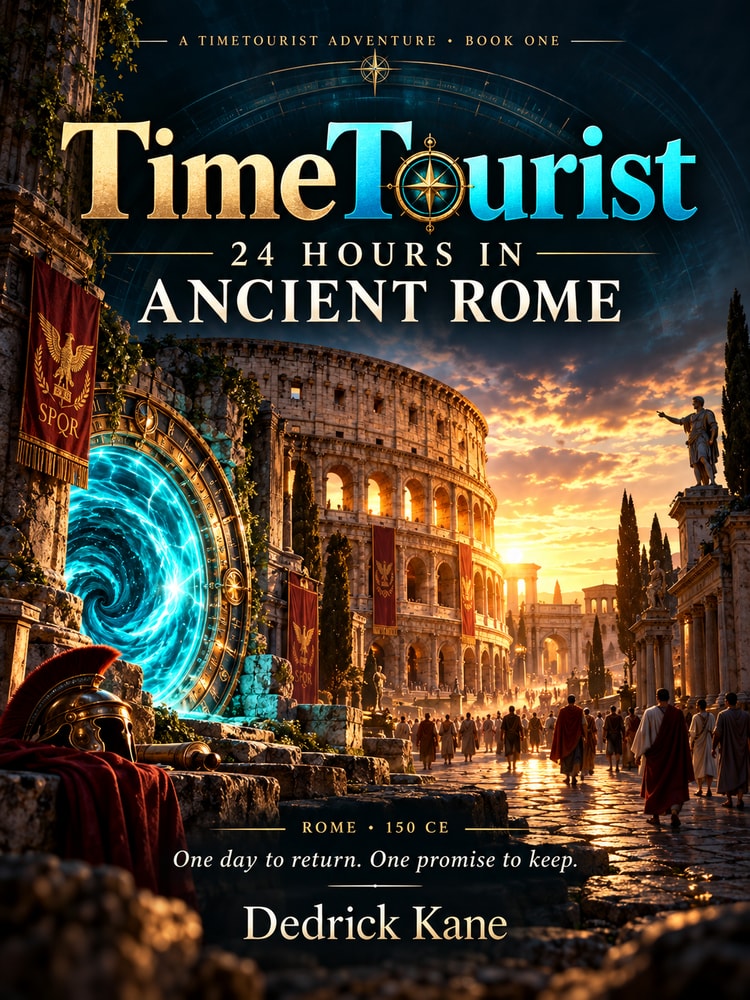
24 Hours in
Ancient Rome
You have twenty-four hours in Ancient Rome. The people you meet have the rest of their lives.
You wake beside a sacred spring in Rome, 150 CE. Your only way home opens at the same spot, at the next dawn. Then a woman who gives you food and borrowed clothes is accused of a debt she cannot pay. Across crowded streets, an amphitheater’s roaring seats and a riverfront warehouse, you have one day to find the truth—and decide what you can honestly promise the people who must stay.
A visitor for a day.
A promise that lasts.
Sabina, a widowed laundry operator, offers you work, a meal and clothes that will let you cross the city without attracting every stare. When a wealthy merchant’s steward demands a ruinous payment, her future and her son’s are placed inside a calculation that does not add up.
Twenty-four oil jars delivered. Forty charged. Sixteen missing.
The answer lies among people with reasons to keep quiet. Following them takes you through the city’s workrooms and public splendor: bath entrances, the amphitheater, the Pantheon, the crowded Forum and the warehouses beside the Tiber.
Written in immersive second person, this historical time-travel adventure pairs a continuous story with cinematic illustrations and historical notes. The story and its AI-generated illustrations are interpretive fiction.
1. The Water That Knows You
Elapsed 00:00–01:15 · Remaining 24:00–22:45
The hand in the water is yours. The voice telling you to take it out belongs to someone who has been dead for eighteen centuries.
At first that is less troubling than the cold. It climbs through your wrist and into the bones of your arm. A moment ago there was a lamp above a workbench, a tiny brush between your fingers, a damaged stone fragment waiting to be cleaned. Now your knees are on paving. Water moves against a straight stone edge. Your brush is gone.
“Not in there,” the voice says. “Are you deaf?”
A woman stands over you with a jar against her hip. She is old enough to have stopped explaining herself to fools. A dark wet patch runs down the front of her tunic. Beyond her shoulder, a column rises into a blue so clear it looks unfinished.
Continue reading the opening chapter
Your hand comes out of the water. Nothing has changed about it except that it is empty.
“Good. Move.”
She shoulders past. Her jar knocks the stone with a hard clay sound. You try to stand and discover that your legs do not agree on how far away the ground is. The woman catches your elbow before your forehead strikes the basin.
“Wine before daylight,” she says. “A fine beginning.”
“I haven't—”
The words she used had not been English. You know that now. There was one sound, quick and rough, and another meaning arriving close behind it. The instrument on your wrist is warm.
You pull your sleeve back.
ROME / 150 CE.
Below that, a number changes.
23:59:18.
The lab technician had joked that everyone looked at the destination first. Look at the clock, she had told you. If this ever works, the clock matters more than the emperor.
It was supposed to be a joke because it was not supposed to work today.
“Where did you get that?”
The water carrier is looking at the light beneath your sleeve. You cover it.
“An injury.”
She examines your face, then your shoes. Their thick rubber soles are damp. One of the laces has loosened. You have never been aware of how many small decisions a shoe announces about the world that made it.
“Bad physician,” she says, and takes her jar away.
The square beyond the basin is becoming a workplace. A man with a broom sweeps grit from the lower step of a temple. Two boys carry a basket between them. Somewhere a hammer strikes three times, pauses, strikes again. The air contains wood smoke, wet stone, and something sour that you recognize only when a small brown pile catches your eye beside a wall.
It is not a reconstruction. That is the sentence you cannot make yourself think all the way through.
There are reconstructed streets at museums. There are actors. There are projections so convincing that you once put out a hand to steady yourself against a wall that was not there. All of those experiences had an edge. You could turn, see a fire door, find the person wearing a badge.
Above you, the temple's carved figures have paint in the folds of their clothes. A bird moves across the face of one of them and vanishes beneath the roof. No speaker supplies its call.
Your wrist vibrates. Under the sleeve, the second line of the display is visible through the cloth.
RETURN AT ZERO.
You remember the briefing room. A diagram of a circle. A lecturer who would not answer questions about what happened outside it because the answer was already on the diagram.
“Within two meters of the origin. Not two meters from where you think it was. From where the apparatus recorded it.”
You turn to the basin. A thin pale vein crosses the paving where your knee had rested. Beside it is a chip shaped like a broken thumbnail. You fix both in your mind.
The stone fragment on the bench had been part of a water basin. Your job was to examine a cleaned surface against a scan. You had agreed to help with the survey trials, to wear the contact and sit through the training. No one had asked you to travel before breakfast. The display had flashed during calibration; you had reached to protect the fragment from the falling lamp.
Then the cold water.
A laugh makes you look up.
Three men are watching you from beside the temple steps. One points to your trousers. Another says something the interpreter fails to resolve, then supplies a meaning too late to prevent the others laughing.
Standing here for a day would preserve the return point. It would also give everyone in the Forum a chance to ask what you are.
You look for a place to sit. The shaded side of the basin seems reasonable until a priest's assistant, or a man dressed like one, raises two fingers and directs you away. You obey. Even without the meaning, his expression is clear.
At the far end of the paving, a child is trying to move a basket out of a mule's path. The load is too large. The mule driver has a stick and a strong opinion about where the child ought to be. You step toward them before deciding whether that is wise.
The basket holds folded clothes. Damp fabric has made it heavy. Your first lift sends the upper layer sliding toward the stones.
“Under it,” someone says. “Hands under.”
A woman in a faded brown tunic catches the falling bundle against her chest. Her right forearm is reddened and the skin around her nails pale from work. She gives you a look that manages to include gratitude and disappointment.
“If you mean to help, hold the bottom.”
You do. Together you move the basket into the narrow space beside a column. The mule passes. Its flank is warm enough to feel without touching. The driver says something over his shoulder that the woman chooses not to hear.
“You should thank him,” the child says.
“For missing my basket?”
“For not hitting it.”
The woman snorts. “A generous morning.”
The child is a boy of perhaps ten, hired for a task he does not like. He digs beneath the clothes for a strap. A wooden rectangle tumbles out onto the paving. The woman takes it before you can bend.
It opens briefly in her hands. A dark surface, scratches, four or five short rows. She closes it and tucks it inside the neck of her tunic.
“Something valuable?” you ask.
Her eyes sharpen. “To me.”
The boy has already started dragging one handle of the basket. You take the other. He protests until the woman tells him to save his breath for the hill.
“Which hill?”
“The one in front of you,” she says.
You put the basket down.
“I can't go far.”
“Then don't.”
She means it. She does not coax. For a moment you dislike her for making the choice so simple.
The temple steps are filling. A man in a garment so elaborately folded that it must prevent useful movement is followed by two people carrying his things. One of them watches the basket with an interest that has nothing to do with the clothes. Across the paving, your water carrier is still talking about you.
You turn back to the basin. Beyond it, the temple's high columns stand in a straight row. A pair of carved men lead carved horses nearby. You have seen photographs of the place with three columns left. Remembering those photographs while looking at the whole building makes you briefly nauseated.
“What is that water called?”
The woman studies you.
“Juturna's.”
“And this temple?”
“The Castors. Do you need every name before you carry something?”
You repeat Juturna under your breath. A return point needs a name that another person can understand.
“I'll carry it a little way.”
“That would be useful.”
The handle cuts across your fingers. The boy is more pleased by your discomfort than he is grateful for your help. He tries to lengthen his stride so that you take more of the weight. The woman spots it immediately.
“Equal,” she tells him.
You leave the open paving through a flow of people who all appear to know which direction they need. The city closes around you. There are stalls under projecting roofs, doors open to rooms that are still dark, smells coming from drains and kitchens and bodies. A loaf passes from a hand into a cloth. Coins strike a table. Somewhere above the street, a woman calls to someone you cannot see.
A tall block has windows that seem scarcely larger than your head. Washing hangs from one of them. Your companion glances up when something drips, shifts her basket without looking down, and avoids the drops. You do not. They land on your shoulder.
“Water?” you ask.
“Probably.”
That word does not reassure you.
The street rises. Your shoes, which should be the best things you possess, slide on a polished stone. The boy notices and grins. A vendor lays out small clay lamps. Some are plain, some carry faces or animals or designs whose purpose is clear enough to make you look away before the boy catches that too.
“You're not from here,” the woman says.
“No.”
“From where?”
You consider saying Britain. It is a name that belongs in this world, but it would lead to questions about places and people and journeys. A lie with a recognizable address is a lie that someone can test.
“A long way away.”
“All travelers say that until you ask who paid for the road.”
“I work with stone.”
She looks at your hands. “You clean it?”
“Sometimes.”
“Then you can clean cloth.”
The basket dips as the boy steps into a hollow. You correct the weight too sharply and knock his knuckles against the handle. He curses. You apologize. The apology appears to surprise him more than the pain.
“Peregrinus,” the woman says.
For an instant you think she has asked a question. Then the interpretation catches up. Stranger. Traveler. A word large enough to conceal the distance you have come.
“Is that what I should call you?”
“For now.”
“For now costs more.”
She says it lightly, but you cannot decide whether she is joking.
At a junction, a man has set a basket of herbs beside a small painted shrine. He touches the stone before lifting his stock. Nobody stops to explain the gesture. The city does not pause for your ignorance. People worship while getting ready to sell vegetables; somewhere a sacred spring waits beside a place of business, and you have put your hand in it as though it were a sink.
Your father's voice arrives without warning. Ask before you touch.
He had said that in museums when you were small. He had continued saying it after you began earning a living by touching things older than nations. The last time he called, you were balancing a repaired vessel on foam supports. You said you would call back when it was safe to leave it.
You had made the vessel safe. You had not called.
“Are you ill?” the woman asks.
“No.”
“Then breathe through your mouth on this stretch.”
The smell explains why. A doorway ahead opens on vats and hanging fabric. The boy puts his handle down with relief. You lower yours more carefully, grateful for anything that requires your hands.
Inside, a young man is wringing out a cloth. His arms are lean and brown. He looks first at the stranger, then at the basket, then at the woman.
“Another customer?”
“Another pair of hands, if the gods are kind.”
“The gods haven't washed much cloth this month.”
She gives him the basket and tells the boy to collect his payment from the shelf. Then she faces you fully, in her own doorway, where her uncertainty about you is easier to see.
“I'm Sabina. If you work, you can eat. If you steal, I know enough people to make you regret choosing this lane.”
Through the roof opening, a strip of sun crosses the floor. Dust turns in it. The young man sets down the wet cloth and waits for your answer.
You have twenty-two hours and forty-five minutes left. Juturna's spring is behind you. There is no one in the laboratory you can call.
“Show me what to do,” you say.
Advance manuscript excerpt. Text and cover may change before publication. No publication date or price has been announced.
Your next journey awaits.
Discover new historical adventures, book launches,
and exclusive TimeTourist experiences.