A day in Rome, 150 CE
Published · 5 min read · TimeTourist editorial
Beyond the market stalls: work, unequal lives, public spaces and the small clues that keep an imagined Roman day honest.
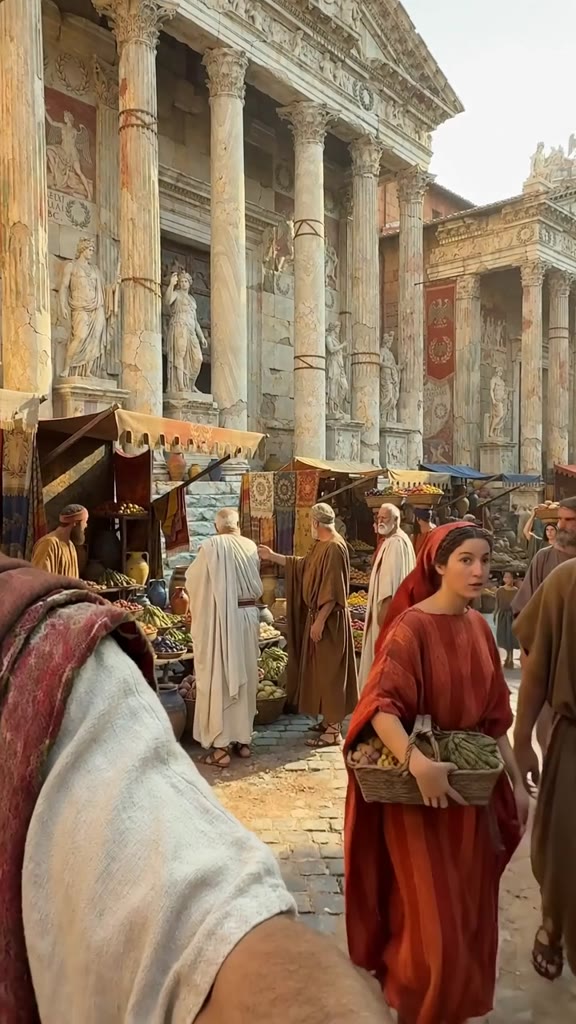
A merchant moves past you. Someone waits beside a stall. Columns frame the street, but your attention is at eye level: hands, goods, faces and the narrow space between strangers. The market in our video lasts only ten seconds. Imagine remaining after the camera stops, with a whole day ahead and no idea who can help you.
That is the starting point of our Rome journey. The year 150 CE gives the imagination a boundary. It does not make every detail in the video accurate. To travel thoughtfully, we need to keep the surviving evidence beside the invented moment—and remember that a city looks different depending on whose day you follow.
Morning: the street is someone’s workplace.
Our market scene is a composite, not a named excavation. For evidence of everyday urban settings, nearby Ostia offers an important comparison. The Italian Ministry of Culture describes its surviving baths, warehouses, shops and multi-storey housing. These are spaces for living and working, not simply monuments to admire.
Ostia is not Rome, and its surviving remains span several periods. We use it as a comparison for the kinds of infrastructure a Roman city could contain. We do not transplant one excavated shop into our unnamed market or assume that every household had the same rooms. The difference between a useful parallel and an exact location is part of responsible reconstruction.
Try following a single object through the frame: a container, a cloth, a basket. The video cannot tell you its owner, price or origin. Yet the question changes what you notice. A stall becomes a meeting point between someone bringing goods, someone offering them and someone deciding whether they can afford them.
Follow the evidence: Italian Ministry of Culture: daily-life buildings at Ostia (Italian)
Before the market opens, another journey has happened.
The official Museum of the Roman Ships at Fiumicino holds riverboats used to transport goods along the Tiber between Portus and Rome. The collection gives physical evidence for a connection a street-level image leaves out: an inland city depended on movement beyond its visible streets.
That does not tell us what is in every basket in our scene. It gives us a better question to ask. Instead of treating the market as a self-contained picture, imagine the route before the purchase—the cargo, the river journey, the landing and the people who carried goods onward. In our Egyptian journey, Merer’s records bring another ancient supply chain into view.
Follow the evidence: Ostia Antica Archaeological Park: Museum of the Roman Ships
The same street, unequal lives.
Rome’s beauty must not erase its coercion. The British Museum’s account of slavery explains the presence of enslaved people in Roman society and the ways people were deprived of freedom. A passing figure in our video cannot be identified as free, freed or enslaved from appearance alone.
A traveller’s freedom to wander is therefore a storytelling privilege, not a universal Roman experience. When we imagine accepting help, ordering a meal or borrowing clothes, we should also ask who has the power to refuse. The scene makes you the visitor. It cannot make the lives around you equally secure.
This is why our fiction follows consequences as well as spectacle. An outsider might count the hours until departure; the people they encounter must live with what happens afterward. That tension belongs to the invented adventure. The inequality that makes such a question necessary belongs to the historical setting.
Follow the evidence: British Museum: slavery in ancient Rome
Midday: read a monument before you walk past.
The Temple of Antoninus and Faustina provides a particularly useful date check. The archaeological park explains that it was founded in memory of Faustina and that Antoninus’s name was added after his death in 161 CE. In our 150 CE setting, that later dedication has not happened.
Today’s façade therefore shows a chapter our imagined visitor cannot yet read. Later adaptation into a church added another layer. An attractive reconstruction can accidentally borrow details from different centuries; a small inscription is enough to reveal the mistake. Dates matter even when the larger silhouette looks familiar.
On your next real visit, choose one detail and ask when it arrived. You do not need to memorise an entire imperial chronology. A name, a doorway or a reused element can turn a famous ruin into a sequence of decisions made by people in different worlds.
Follow the evidence: Colosseum Archaeological Park: Temple of Antoninus and Faustina
Later: a city has shared spaces, too.
The Metropolitan Museum’s discussion of bathing places Roman baths across the empire and explains their social role, as well as washing. Baths invite us to imagine a day that extends beyond buying and selling. They also remind us not to confuse public infrastructure with equal access to every comfort.
We do not prescribe one universal schedule for a Roman resident. Occupation, household, status and circumstance would change the day. Morning market, midday monument and later bath are a way to explore questions, not an excavated diary of one person’s movements. The camera’s confident viewpoint should not disguise that uncertainty.
Follow the evidence: The Metropolitan Museum of Art: baths and bathing culture
Watch again, with better questions.
First watch the people. Then watch the space between them. Finally watch the architecture. Which details carry the story, and which would need independent evidence? Our clothes, sounds, conversations and arrangement of stalls are creative choices. Even a plausible detail can be wrong for the particular year or place.
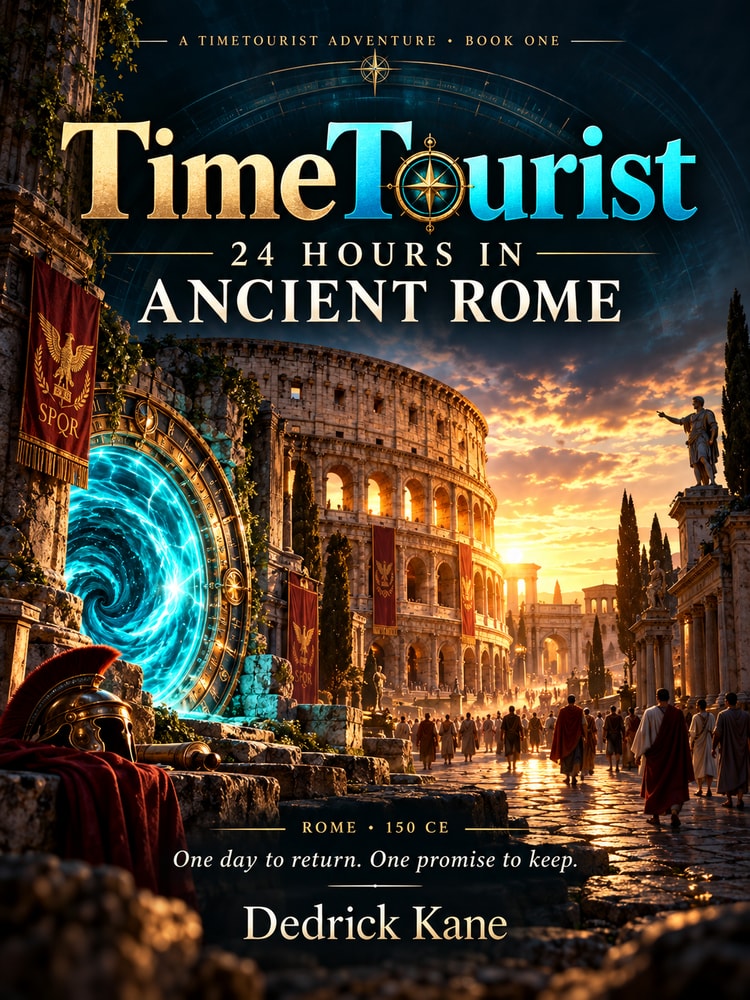
A good journey leaves room for that distinction. The video offers a doorway; sources help you decide what lies beyond it. If you want to stay with the fictional visitor, the opening of 24 Hours in Ancient Rome is your next step. If you want the surviving landscape, follow the Forum visitor information. Both begin with the same act: looking a little closer.
Evidence & imagination
What the evidence establishes
Archaeological sites and museum collections preserve urban buildings and transport evidence. The temple’s dedication changed in 161 CE. Slavery was part of Roman society.
Our interpretation
Ostia is a comparative Roman urban setting. Our sequence of daily activities is an editorial route through historical questions, not a documented individual’s itinerary.
What we dramatized
The market location, people, dialogue, ambient sounds, precise clothes, stalls and POV traveller are invented. The 150 CE date anchors this article and our fiction; the generated video does not establish that date.