How were pyramid stones moved?
Published · 4 min read · TimeTourist editorial
Follow a block from quarry to river to building site—and separate the evidence from the drama in our pyramid POV video.
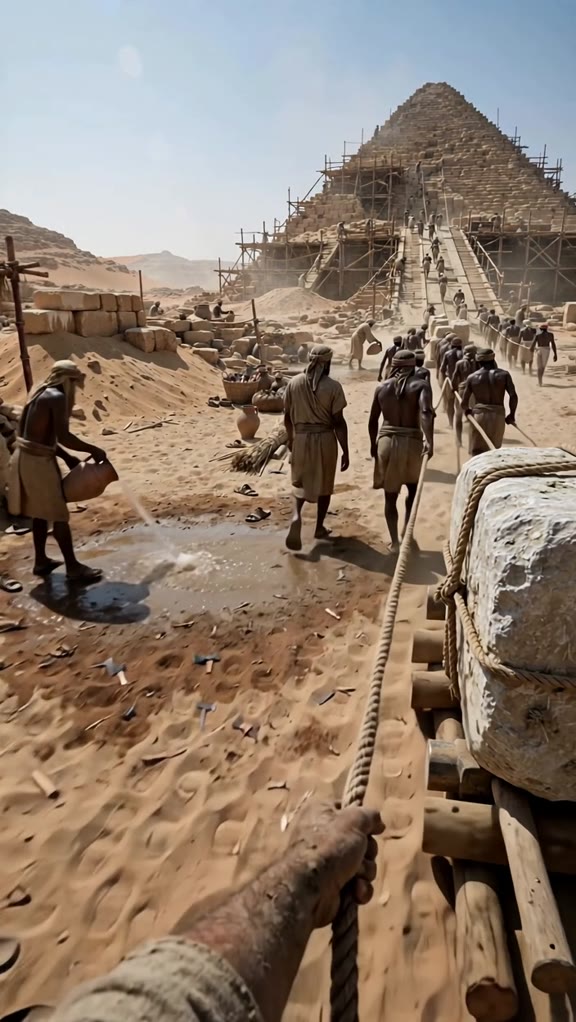
You lean into a rope. Ahead, an enormous block seems to resist every step. The pyramid rises beyond it, promising a destination that still looks impossibly far away. Our ten-second scene makes the struggle immediate. It also hides the most interesting part of the question: the block has already travelled before you begin pulling.
Moving pyramid stone was a chain of problems. Where did the material come from? How did it reach Giza? What happened between the landing place and the building? And how was it raised into position? Evidence answers some of those questions much better than others. A convincing image cannot fill the gaps by itself.
Start with the stone, not the rope.
The Egyptian Ministry of Tourism and Antiquities distinguishes the Great Pyramid’s local limestone from its fine exterior casing, brought from Tura by ship. That distinction changes the journey. A nearby quarry and a river shipment are different operations; there was no single route for every block.
Look again at the video and ask what its block is supposed to be. The scene does not identify a quarry, material grade or intended position in the monument. Those omissions are fine in a brief adventure, but they prevent us from treating the image as a reconstruction of one documented delivery. Even a stone’s destination inside a building matters to the story of its movement.
Follow the evidence: Egyptian Ministry of Tourism and Antiquities: The Great Pyramid
A delivery record survives.
In the published translation of Merer’s diary, his crew loads stone at Tura, travels toward Akhet-Khufu and returns for more. Akhet-Khufu is the Great Pyramid’s complex. These entries bring transport out of the realm of speculation: a working crew, cargo and repeated journeys appear in an administrative record from Khufu’s reign.
The diary is powerful precisely because it is ordinary. Repetition, overnight stops and the return trip belong to a job that must happen again. A monument’s construction is easier to imagine when you stop seeing one heroic heave and start seeing a supply chain. Read our connected Merer journey to follow that quieter adventure on the water.
Follow the evidence: Pierre Tallet / IFAO: Merer’s diary, English translation (PDF)
Could wet sand make hauling easier?
University of Amsterdam researchers tested a sled on sand and found that the right amount of moisture reduced pulling resistance. Water helps grains bind together, limiting the pile of sand that forms in front of a sliding load. Too much water does not give the same benefit. This is an experiment about physical behaviour, not a recovered instruction manual for the Great Pyramid.
The researchers also discuss a painted scene in Djehutihotep’s tomb showing water poured ahead of a sled carrying a statue. It is a Middle Kingdom scene, centuries later than Khufu. It is relevant evidence for Egyptian heavy transport, but its date and its cargo matter: a later statue-hauling image cannot certify every step of an earlier pyramid operation.
Follow the evidence: University of Amsterdam: experiments with wet sand · University of Amsterdam: Sliding friction on wet sand (research chapter, PDF)
What about the rollers in our video?
Our generated scene shows timber beneath the load, a ramp, ropes and a conveniently visible line of workers. That arrangement was chosen by an image-generating system to make the action readable. We have no source establishing that exact combination for this location, reign or block. The logs should be read as dramatization.
A useful way to watch is to pause at the ground. Is the load sliding or rolling? Where does the rope lead? How is the route maintained? Does the frame show the full hauling team? These questions turn the video into an invitation to investigate, rather than an answer that looks complete because the camera is close to the action.
The work beyond the frame.
AERA’s excavations at Giza reveal a settlement with spaces for administration, food production and living. Much of the surviving Heit el-Ghurab evidence belongs to Khafre and Menkaure, after Khufu. It helps us see the infrastructure of pyramid building across the Fourth Dynasty; it is not a floor plan of the precise camp in this imagined moment.
Hauling is only the action the camera follows. Ask who organised the next delivery, maintained equipment, supplied food or recorded what arrived. Those roles broaden the adventure from muscle to coordination. They also remind us that showing people working does not reveal their legal status, their obligations or how they experienced that work. We cannot infer a whole society from a row of figures.
Follow the evidence: AERA: Settlement and Cemetery at Giza (PDF)
What we still cannot show you with certainty.
Transport to the site and lifting into place are separate questions. The Ministry’s account explicitly acknowledges uncertainty about how the Great Pyramid was constructed. Our video’s ramp is therefore an imagined solution, not a claim that archaeology has settled its layout. We do not attach a precise block weight, crew size or construction timetable to the scene.
On a visit to Giza, try reading the landscape as a sequence: stone source, water approach, landing, working ground, rising monument. You will not recover every missing step. You will gain something more useful than a single spectacular explanation—a clearer sense of which questions the evidence can answer, and which remain open.
Follow the evidence: Egyptian Ministry of Tourism and Antiquities: The Great Pyramid
Evidence & imagination
What the evidence establishes
The Great Pyramid used local limestone and shipped Tura casing stone. Merer’s diary records stone transport. Giza settlement archaeology documents the wider organisation of pyramid work.
Our interpretation
Sled experiments demonstrate a benefit from appropriately damp sand. A later Egyptian hauling image is suggestive, but neither proves the complete Great Pyramid construction method.
What we dramatized
Our POV traveller, faces, voices, block dimensions, timber rollers, ramp geometry, clothing details and exact work sequence are invented. The video is not evidence.