Merer’s Nile: the journey before the pyramid
Published · 4 min read · TimeTourist editorial
An ancient delivery diary turns a distant monument into a working landscape of boats, overnight stops and people with jobs to finish.
Before the rope tightens on the building site, imagine a quieter moment: a loaded boat waiting to leave. The monument is not yet in the frame. Someone must get the cargo there, record the work and return for another load. The adventure is less spectacular than a rising pyramid, but a remarkable ancient document lets us follow part of it.
This journey is built around Merer’s diary, published by Egyptologist Pierre Tallet through the French Institute of Oriental Archaeology. It is not a new video, and the imagined viewpoint below is ours. The underlying delivery entries are evidence. Keeping those two things separate makes the surviving record more interesting, not less.
A few days that survive on a page.
In Papyrus B, section B I, the translated entries describe work at Tura South, departure with stone, an overnight stop at She-Khufu, arrival at Akhet-Khufu and the return toward Tura. The following days bring more hauling. The place names are ancient; the pattern feels recognisable—a delivery has stages, and completion means preparing to do it again.
The published translation uses brackets and question marks where the text is damaged or a reading uncertain. Keep them in mind when you read it. A modern retelling can accidentally sound more definite than the document. We paraphrase the sequence rather than silently repairing its gaps or inventing a conversation aboard the boat.
Follow the evidence: Pierre Tallet / IFAO: Merer’s diary, English translation (PDF)
The monument depends on its approach.
The Ministry’s account of the Great Pyramid explains that its exterior was once covered in fine limestone shipped from Tura. Picture the difference between seeing a completed face and coordinating the material that could become it. The delivery record helps connect a monumental destination to the work beyond the plateau.
It does not give us a complete cargo manifest for every boat in every entry. Nor does it show exactly where each block ended up. Our scene-setting stops short of naming a vessel design, a precise load weight or a particular day’s weather. Those would require evidence beyond the sequence we are following.
Follow the evidence: Egyptian Ministry of Tourism and Antiquities: The Great Pyramid
Read for people, not only kings.
A king’s monument invites attention upward. A delivery diary pulls it back toward the crew. Someone keeps the account of work and movement; the entries distinguish days spent hauling from days spent travelling. Those small distinctions let us think about labour as a sequence of tasks rather than a single undifferentiated effort.
The record does not open a window onto everyone’s feelings. It cannot tell us that a worker enjoyed the voyage, resented an order or missed someone at home. We resist giving those emotions the authority of a source. But the question itself is valuable: what would be missing from our picture if we remembered only the king’s name?
Follow the repeated return journeys with your finger. The route is not an arrow that ends at Giza; it is a loop. That loop changes the monument’s scale in the imagination. It means organisation, continuity and people who have another task after the moment that makes it into a film.
Follow the evidence: Pierre Tallet / IFAO: Merer’s diary, English translation (PDF)
A river route is not a ramp diagram.
Merer’s diary tells us about movement to the pyramid complex. It does not settle how stone was raised through every course of masonry. A boat arriving and a block being lifted are different operations. Joining them with an invented ramp would turn a real record into a claim it cannot support.
This distinction is useful beyond Egypt. Whenever a dramatic explanation appears to solve a whole construction project, ask which stage its evidence actually describes. A route, an experiment and an excavated structure may answer different questions. They become stronger when we let them keep their separate limits.
Try reading the diary yourself.
Open the IFAO translation linked below and begin with Papyrus B, section B I, on printed page 150. Mark the places, then the verbs, then the overnight stops. You do not need to read ancient Egyptian to notice the rhythm of an administrative account. Let the repetition be the discovery.
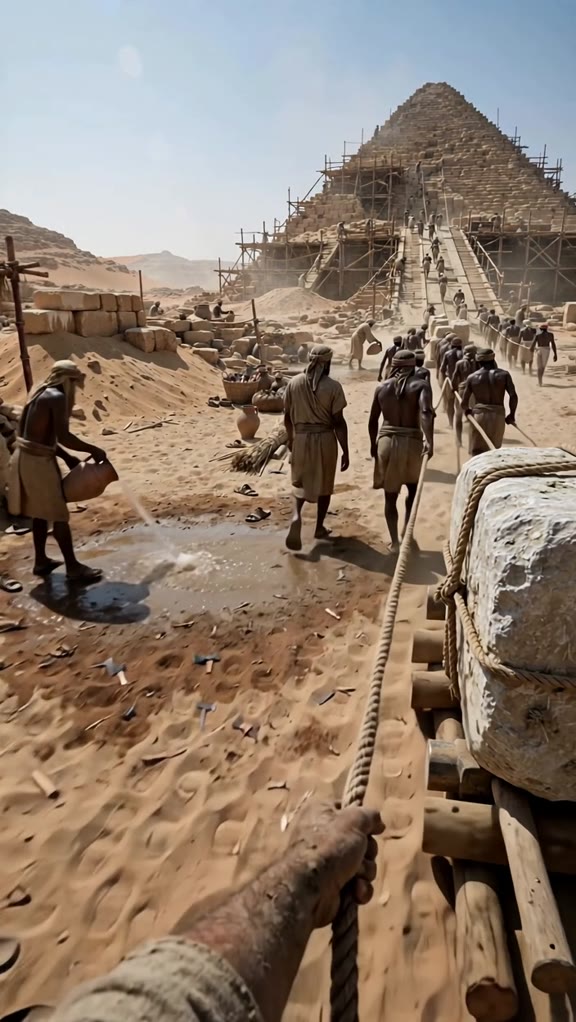
Then return to our pyramid-hauling video. The stone in front of the camera now suggests a longer journey, even though the image cannot identify its cargo history. Continue to “How were pyramid stones moved?” for the sled experiment, the later hauling image and the limits of our dramatization. The most rewarding route through history often starts with the detail a spectacular view leaves out.
Evidence & imagination
What the evidence establishes
Merer’s published diary records a crew transporting stone from Tura toward Akhet-Khufu, with overnight stops and return journeys.
Our interpretation
We read the repeated entries as a way into the organisation of work. The imagined boat-side viewpoint is an editorial invitation, not recovered testimony.
What we dramatized
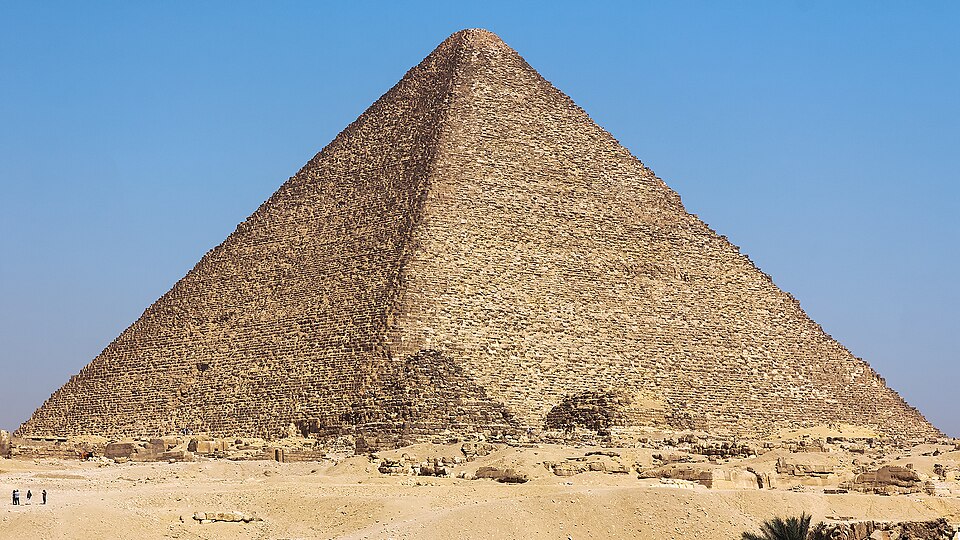
No dialogue, vessel reconstruction, crew emotions, weather, exact cargo weight or complete ancient river map is claimed. Our pyramid photograph shows the site today.